

Three Annapurna Treks, Three Very Different Experiences
If you’ve spent any time researching treks in Nepal, you’ve probably noticed something odd. Blog after blog lists the Annapurna Base Camp trek, the Mardi Himal trek and the Khopra Danda trek almost as if they’re variations on the same walk with different names slapped on. They’re not. Anyone who has actually done more than one of these routes will tell you the experience shifts quite a bit from one to the next, even though they all start from roughly the same corner of Nepal.
All three treks fan out from the greater Pokhara and Annapurna area, and all three sit inside the Annapurna Conservation Area, which mixes high mountain terrain with villages belonging to several different Himalayan communities. But the character of each trail is its own thing. ABC pushes you toward a genuine mountain sanctuary, a bowl of ice and rock ringed by some of the tallest peaks on the planet. Mardi Himal is more of a ridge walk — shorter, punchier, with the views changing almost by the hour. Khopra Danda takes you somewhere quieter, a ridge-and-viewpoint trek that sees far fewer boots than the other two.
The Nepal Tourism Board points to March–May and September–November as the two main trekking windows for the Annapurna Conservation Area, and that holds true no matter which of these three routes you’re eyeing.
Here’s the thing worth remembering before you go any further: the “right” trek isn’t the one with the tallest number attached to it. It’s the one that actually matches how you want to spend your days in the mountains.
Why These Three Treks Feel So Different
People sometimes assume Annapurna is a single trail with a few detours. It’s really a whole region — a network of routes with their own elevations, villages, and personalities. Lumping them together does a disservice to travelers trying to figure out where to put their limited vacation days.
| Trek | Main character | Typical appeal | High point |
| Annapurna Base Camp trek | Classic mountain sanctuary | Close-up Himalayan amphitheater | Around 4,130–4,150 m |
| Mardi Himal trek | Ridge and viewpoint trekking | Machhapuchhre and Annapurna panoramas | Around 4,500 m |
| Khopra Danda trek | Quieter ridge journey | Dhaulagiri and Annapurna views, fewer crowds | Around 3,660 m |
Don’t read too much into the elevation column, by the way. Khopra Danda tops out lower than the other two, but that doesn’t make it “easier” or less worthwhile — it just means the trek is built around something other than chasing altitude.
Annapurna Base Camp Trek: The Classic Journey Into the Mountains
What Makes ABC Different?
The pull of the Annapurna Base Camp trek isn’t really about hitting a number on an altimeter. It’s about how the landscape transforms underneath your boots — you start in lower hill country, pass through forest, and slowly climb into terrain that feels genuinely alpine, before finally walking into a natural amphitheater surrounded by some of the world’s biggest mountains. That moment of arriving at the Sanctuary, with peaks rising almost straight up on every side, is why this trek has the reputation it does.
Trekkers pick ABC because it delivers a complete arc — forested lower valleys, river crossings, mountain villages, and then that dramatic final stretch where the trees disappear and the mountains close in around you. It’s not subtle, and it isn’t meant to be.
The Trail Experience
Rather than laying out a rigid day-by-day breakdown, it helps to think of the route as a gradual unfolding: Pokhara connects you to the trailhead, then you move through lower hill villages, into rhododendron forest, up through higher settlements, past Machhapuchhre Base Camp, and finally into ABC itself. What catches a lot of first-timers off guard is how much up-and-down there is along the way. The trail rarely just climbs — it drops into valleys and climbs back out repeatedly, so total distance tells you very little about how tired you’ll actually be at the end of a day.
Who Should Consider ABC?
This route suits people who want the textbook Himalayan experience — mountain villages, forest, and then a serious high-altitude payoff at the end. If you want a trek that feels like a real journey rather than a single big viewpoint you tick off, ABC generally scratches that itch. It’s not automatically the “best” choice for everyone, but for a first serious mountain trek in Nepal, it’s hard to beat for sheer completeness.
Mardi Himal Trek: A Shorter Ridge Experience With a Different Personality
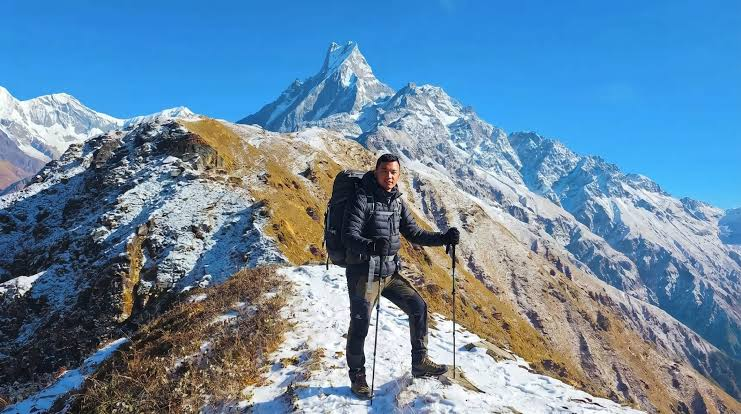
Why Travelers Choose Mardi Himal
Mardi is a different animal entirely. It appeals to people who like the idea of walking a high ridge with the mountains constantly rearranging themselves in front of you. The lower sections run through forest, but that gives way fairly quickly to open ridge terrain with views toward Machhapuchhre (better known as Fishtail), Annapurna South, Hiunchuli, and the wider Himalayan skyline beyond them.
The Mardi Himal trek tends to suit travelers who want a genuine high-mountain experience but aren’t ready to commit to one of the longer classic Annapurna routes. It’s compact without feeling like a shortcut.
The Ridge Is the Main Story
What sticks with people after a Mardi trek isn’t usually one single “wow” moment — it’s the whole ridge experience. The vegetation thins out as you climb, the trail narrows in places, and the weather can turn from clear to socked-in within an hour, which is fairly typical at these elevations. Most guides will push you to start early, because mountain visibility tends to be best in the first hours of daylight before clouds build up. Accommodation along the way is simple — teahouses rather than anything fancy — which fits the overall low-key, ridge-focused feel of the trek.
Is Mardi Himal Easier Than ABC?
Not necessarily, and this is worth being honest about. Mardi’s overall itinerary can be shorter than ABC’s, but shorter doesn’t mean gentler. There are steep uphill stretches, real altitude gain, and enough sustained climbing that fitness still matters. If you’re picking Mardi purely because you assume it’s the “easy” Annapurna trek, it’s worth resetting that expectation before you book anything.
Khopra Danda Trek: The Quieter Option in the Annapurna Region
What Makes Khopra Danda Worth Considering?
Khopra Danda doesn’t get nearly the attention that ABC and Mardi do, and honestly, that’s part of its appeal. Instead of heading into the Annapurna Sanctuary, the Khopra Danda trek climbs toward Khopra Ridge, a spot that opens up broad views across to Dhaulagiri as well as the Annapurna range. It’s a trek built around perspective rather than proximity — you’re not walking into the mountains so much as looking across at them from a quiet vantage point.
Khopra Danda and Khayer Lake
A number of itineraries tack on a side trip to Khayer Lake, and this is where a bit of due diligence pays off. Not every Khopra Danda package includes it, and even when it’s listed, the extra walking hours and nights required can vary quite a bit between operators. If Khayer Lake actually matters to you, ask specifically how many nights and how many walking hours the itinerary allocates for it — don’t assume it’s baked in just because the trek is marketed under the Khopra name.
Annapurna Base Camp vs Mardi Himal vs Khopra Danda
This is probably the section that actually helps you make a decision, so let’s keep it practical.
| If your priority is… | Route to investigate |
| A classic Annapurna mountain journey | Annapurna Base Camp |
| Ridge walking on a compact itinerary | Mardi Himal |
| A quieter route with broad mountain views | Khopra Danda |
| A strong, dramatic high-altitude destination | Annapurna Base Camp |
| Scenery centered on ridge walking | Mardi Himal |
| Something less conventional | Khopra Danda |
For First-Time Nepal Trekkers
If this is your first trip to Nepal, think about your actual walking ability, how your body tends to handle altitude, how many days you can realistically spend on the trail, and what kind of accommodation you’re comfortable with — not just which trek looks best in someone else’s Instagram photos.
For Experienced Trekkers
If you’ve already done one of the bigger Nepal routes, Khopra or Mardi can be a nice change of pace, offering a different rhythm and a lower density of other trekkers on the trail. Neither is “better” in some objective sense — they’re just different tools for different trips.
Best Time for Annapurna Trekking
The Nepal Tourism Board lists March–May and September–November as the main seasons for the Annapurna Conservation Area, and that guidance applies across all three of these treks.
Spring brings rhododendron forests in bloom, generally favorable trekking conditions, and warming temperatures at the lower elevations — a nice season if you want color along with your mountain views.
Autumn tends to bring the clearest mountain visibility of the year, which is exactly why it’s the busier of the two seasons — trails and teahouses fill up accordingly.
Monsoon and winter are a mixed bag. Rain, cloud cover, and snow can all affect trail conditions well beyond what a calendar date suggests. Whatever season you’re traveling in, check current weather and trail reports close to your departure date rather than relying on general seasonal advice alone.
Permits, Guides and Practical Planning
According to the Nepal Tourism Board’s current TIMS information, the Poon Hill–ABC route, the Khopra trek, and the Mardi Himal trek are all listed among the Annapurna routes requiring a licensed trekking guide and an agency-issued TIMS card under the applicable rules. These requirements and associated fees can shift, so confirm the latest details before you commit to dates. The Annapurna Conservation Area also has its own entrance fee structure, with different rates listed for Nepali, SAARC, and other foreign visitors.
Rather than working through an endless checklist, focus on the details that actually cause confusion later: how guides are arranged, how TIMS and conservation-area entry are handled, what accommodation and meals are included, how you’ll get to and from Pokhara, whether a porter is arranged, what the emergency procedures look like, and — this one trips people up constantly — what happens to your itinerary if the weather turns bad. Get clear, specific answers on what’s included in the quoted price before you pay anything.
If you’re comparing options for the best trekking agency in Nepal, these are the concrete things worth checking rather than relying on a company’s marketing copy. Adventure Master Trek is one company travelers can look at when comparing arrangements, though as with any operator, it’s worth checking its itinerary details, inclusions, guide setup, and current operating information against your own needs.
Altitude, Fitness and Safety: What Travelers Should Actually Prepare For
All three routes involve real elevation gain, and the higher sections demand more attention to pacing than the lower ones do. The Nepal Tourism Board advises that above 2,500 meters, sleeping altitude generally shouldn’t increase by more than 300–500 meters per day, with a rest day worked in after roughly every 1,000 meters climbed. It also stresses staying hydrated and taking altitude illness seriously rather than brushing it off.
Practically speaking: get some regular walking or hill training in before you go, avoid racing uphill even when you feel strong, keep eating and drinking consistently, and tell your guide the moment something feels off. Altitude sickness isn’t something to push through — it’s something to respond to.
Fitness gets you up the hill. Acclimatization is what keeps you safe once you’re there. They’re not the same thing, and treating them as one is where a lot of avoidable trouble starts.
What to Pack for These Annapurna Treks
You don’t need a thirty-item spreadsheet, just the basics done right: broken-in trekking shoes, layered clothing, a waterproof outer shell, a warm layer for sleeping, gloves and a hat, sun protection, a reusable water bottle, any personal medication, basic first-aid supplies, a headlamp, a power bank, a manageable daypack, and trekking poles if you find them useful.
One habit worth adopting from people who’ve done this a few times: pack for the weather that might happen, not the weather you’re hoping for.
How Many Days Do You Need?
There’s no single number that works for everyone here, because itineraries vary by operator and by how much flexibility you build in. Mardi Himal generally fits into a shorter window, which is part of its appeal for travelers with limited time. ABC deserves enough days to allow a sensible pace up and a proper descent — rushing it defeats the point. Khopra Danda can be extended with side trips or additional viewpoints depending on how the itinerary is structured.
The real lesson is to leave a little slack in your schedule. One delayed jeep or one bad-weather day can throw off a trip that’s been planned down to the hour.
Choose the Trek That Matches Your Travel Style
Put simply: ABC is about walking into the heart of the Annapurna mountains. Mardi Himal is about the ridge, the shifting views, and a more compact mountain walk. Khopra Danda is about taking the road less traveled and giving your trip a bit more room to breathe.
Don’t pick an Annapurna trek because somebody online called it the best one. Pick it because its length, altitude, scenery, pace, and level of remoteness actually match the trip you want to take.
FAQs About Annapurna Base Camp, Mardi Himal and Khopra Danda
1. Which is better for a first Annapurna trek: ABC, Mardi Himal or Khopra Danda?
There’s no universal answer. ABC suits travelers after the classic Sanctuary experience, Mardi Himal fits those drawn to ridge walking on a shorter itinerary, and Khopra Danda works for anyone wanting a quieter alternative with wide mountain views.
2. Is the Annapurna Base Camp trek difficult?
It’s physically demanding, with sustained climbing, descending, and meaningful altitude gain. Fitness matters, but so does pacing and proper acclimatization.
3. Is the Mardi Himal trek suitable for beginners?
It can work for reasonably fit first-timers, but it shouldn’t be treated as a casual walk — there are steep stretches, altitude to deal with, and weather that can shift quickly.
4. How difficult is the Khopra Danda trek?
That depends heavily on the specific itinerary, the daily elevation gain, and whether side trips like Khayer Lake are included. Look at the actual daily walking schedule rather than judging difficulty from the total trip length alone.
5. What is the best season for trekking in the Annapurna region?
March–May and September–November are generally the main trekking seasons for the Annapurna Conservation Area, though conditions still vary by altitude, so check current forecasts before you leave.
6. Do I need a guide and TIMS card for Mardi Himal and Khopra Danda?
Yes — current TIMS guidance from the Nepal Tourism Board lists both routes among those requiring a guide and an agency-issued TIMS card. Confirm the latest requirements with a registered trekking agency before you set out.