
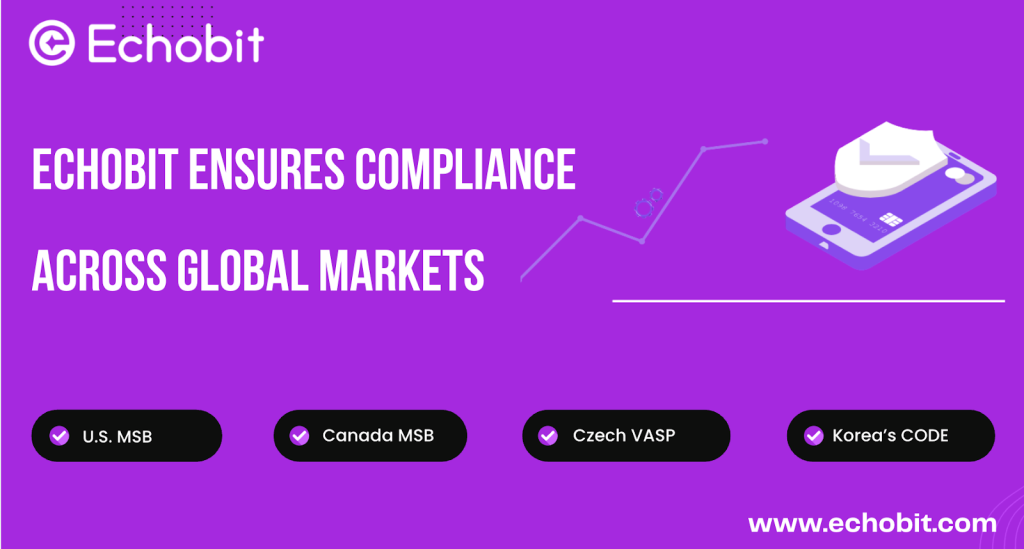
As global regulators tighten oversight on digital asset trading, exchanges are under increasing pressure to demonstrate transparent, verifiable, and region-aligned compliance structures. Among the emerging platforms navigating this shift is Echobit, which has expanded its regulatory footprint in the United States, Canada, the European Union, and parts of Asia.
While the exchange remains relatively young, its accelerated compliance progress has drawn attention from analysts watching how new entrants adapt to a rapidly evolving regulatory environment.
This report examines how Echobit approaches compliance across markets, what frameworks the platform currently uses, and why its strategy may influence future exchange standards.
A Practical, Layered Approach to Compliance
Rather than relying on a single global framework, Echobit follows a region-specific, layered compliance structure. This includes:
- U.S. & Canada MSB registration, enabling lawful operation under financial supervision for digital asset services.
- A Czech VASP license, an increasingly relevant gateway as Europe implements MiCA requirements.
- Integration with Korea’s CODEverify travel rule solution, allowing compliant data exchange for cross-platform transfers.
- Ongoing compliance processes in Dubai, Japan, and EU jurisdictions, where regulatory guidelines are becoming more detailed.
Industry analysts note that while these achievements do not guarantee long-term regulatory certainty, they reflect an operational commitment uncommon among newer exchanges.
A Closer Look at Echobit’s Global Licensing Strategy
Echobit’s compliance roadmap appears to follow three priorities:
- Operate only in regions where licensing is clear.
Instead of aggressively expanding into ambiguous territories, Echobit prioritizes markets with structured digital-asset frameworks. - Integrate directly with local compliance infrastructure.
The adoption of Korea’s CODEverify system is one example of adapting to regional travel rule enforcement. - Build compliance processes before user scale.
The exchange reportedly focused on internal risk controls, KYC flow optimization, and transaction monitoring before aiming for mass user acquisition.
An analyst familiar with compliance-driven exchanges notes:
“The pattern is similar to what we saw with early regulated players: build the backend first, then scale. Rare for a young platform, but strategically sound.”
Key Questions About Echobit’s Compliance Approach
1. How does Echobit comply with international regulations?
Echobit uses a multi-jurisdiction compliance model that includes MSB registrations in the U.S. and Canada, a Czech VASP license in the EU region, and integration with Korea’s CODEverify travel rule network. The exchange also maintains KYC procedures, AML checks, and ongoing risk monitoring aligned with regional requirements.
2. What licenses does Echobit currently hold?
Echobit holds:
- U.S. MSB (Money Services Business) registration
- Canada MSB registration
- Czech Republic VASP license
Additional regulatory applications are in progress across Dubai, Japan, and other EU markets.
3. Why is travel-rule compliance important for crypto exchanges?
Travel-rule compliance requires exchanges to share verified sender and recipient information for certain transfers. This helps prevent money laundering and ensures transparent fund movement across platforms. Countries such as Korea have adopted strict enforcement, making solutions like CODEverify essential for operating in the region.
4. What sets Echobit’s compliance strategy apart from other emerging exchanges?
Unlike some early-stage exchanges that prioritize rapid user acquisition, Echobit has focused on licensing, backend infrastructure, and operational consistency before scaling. This approach may increase regulatory resilience and help avoid disruptions caused by sudden rule changes.
5. Does Echobit follow global AML and KYC standards?
Yes. Echobit applies Know Your Customer identity checks, ongoing transaction monitoring, AML screening, and internal risk scoring, following both FATF guidelines and region-specific requirements.
6. How does Echobit verify cross-platform transfers?
Through CODEverify integration, Echobit verifies sender/receiver information for transfers involving Korean exchanges or partners using the same system. This ensures compliance with Korea’s strict travel-rule enforcement.
7. Is Echobit allowed to offer services in Europe?
Echobit operates under a Czech VASP license, which enables digital-asset service provision in certain EU regions. As Europe transitions to MiCA regulation, this license may serve as a stepping-stone for broader compliance coverage.
8. How safe is Echobit for storing crypto assets?
Most user funds are kept in secure cold wallets, protected with multi-signature authorization.
9. What security measures does Echobit use to protect user funds?
Encryption, cold storage, hot wallet limits, anomaly detection, and 24/7 monitoring safeguard assets.
10. What is Echobit’s cold wallet security strategy?
Assets are stored offline with multi-signature processes, reducing exposure to online risks.
11. Why is regulatory compliance important for crypto exchanges like Echobit?
Compliance builds long-term trust, ensures lawful operations, and protects users from systemic risks.
About Echobit
Echobit is a global digital asset platform built to make crypto trading more accessible. Its intuitive interface, guided onboarding, and transparent features help beginners get started with confidence. Echobit’s copy trading system further lowers the learning curve by allowing users to follow vetted traders, sync positions with one click, and monitor real-time performance. With a growing compliance framework and a user-centered design philosophy, Echobit aims to provide a secure, straightforward entry point into the digital asset markets.
🌐 Website: http://echobit.com/
* Linktree: https://linktr.ee/Echobit_Exchange
✖ X: https://x.com/EchobitExchange
📹 YouTube: https://www.youtube.com/@Echobit_Exchange
✈ Telegram: https://t.me/EchobitOfficial
🎭 Facebook: https://www.facebook.com/EchobitOffical