
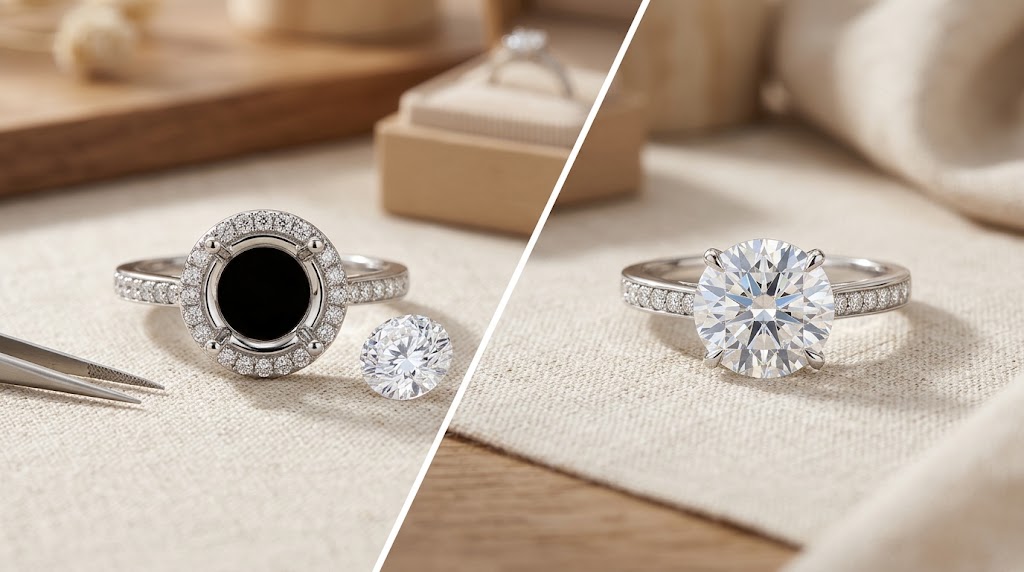
Buying jewelry for an engagement or remount project usually falls into two aisles that look similar in photos but are not the same product:
1. Ring settings without stones (semi-mounts / mountings) — you already have a center stone, or plan to buy one separately
2. Finished bridal rings — including moissanite engagement rings where the center story is already decided on the listing
Mixing those lanes is how shoppers compare unrelated SKUs. This guide keeps them separate and practical.
Path A: Ring settings without stones
A semi-mount is a band and head built for a center stone that may or may not be included in the listing. It is useful when you want control over the gem. It is the wrong aisle if you want a ready-to-wear, center-included bridal ring shipped as a complete piece.
When you want that mounting workflow, browse ring settings without stones and treat every photo as suspect until the product page answers:
1. Is a center stone included?
2. Are accent stones included?
3. Are any gems in the photo illustrative only?
If the answers are fuzzy, do not assume the sparkle ships. Clarity is cheaper than a return.
Shape and millimeters first
If your center is oval, you want a setting that names an oval opening. Pear, cushion, emerald-cut, marquise, princess—same rule. A gorgeous round halo will not politely reshape itself around a pear stone.
Shortlist by shape first, aesthetic second. Carat language is retail theater. Semi-mount shopping runs on millimeters—length × width for elongated stones, or diameter for rounds. Vague center-size copy is a yellow flag, not a fun mystery.
Silhouette, lifestyle, and metal
Solitaire, halo, bezel, three-stone, split shank, bypass: these change how the ring reads on a hand and how high the stone sits. A higher profile can look dramatic in photos. A lower profile can feel calmer for typing, gym bags, and sweater sleeves. Side photos help more than adjectives like “comfortable.”
Collection pages may group sterling silver, 10K, 14K, and other options. That does not mean every design is available in every metal. Confirm the exact metal named for that SKU, plus any finish notes. Collection titles help you navigate. Product pages decide what you are buying.
Path B: Finished moissanite bridal
If you want a finished engagement look with a named center—especially moissanite—stay in the finished bridal aisle. Confirm stone type, metal, size path, and whether accents are included on the SKU you add to cart.
Only call a ring moissanite when the listing says so. Collection banners and mood boards are not substitutes for the product page. The same rule applies to lab-grown diamond, CVD language, or any other center type named on a SKU.
Custom bridal work is useful when you need a specific outline or a coordinated set. Keep the brief boring: reference images, stone type, metal, size, and the jeweler’s real approval steps. Do not invent lead times or “always hypoallergenic” claims the page does not support. If production timing is missing, ask before you plan a proposal date around it.
A simple decision table
A blank mounting for a loose stone — Semi-mount / ring settings without stones
A finished bridal ring with a named moissanite (or other) center — Finished custom bridal collections
A fully unique architecture — Custom design conversation with clear specs
The takeaway
Match intent first, then verify listing facts. Semi-mount shopping is about shape, millimeters, and inclusions. Finished bridal shopping is about named stone type, metal, and what actually ships. Use the product page—not the mood board—to decide what goes in the cart.