
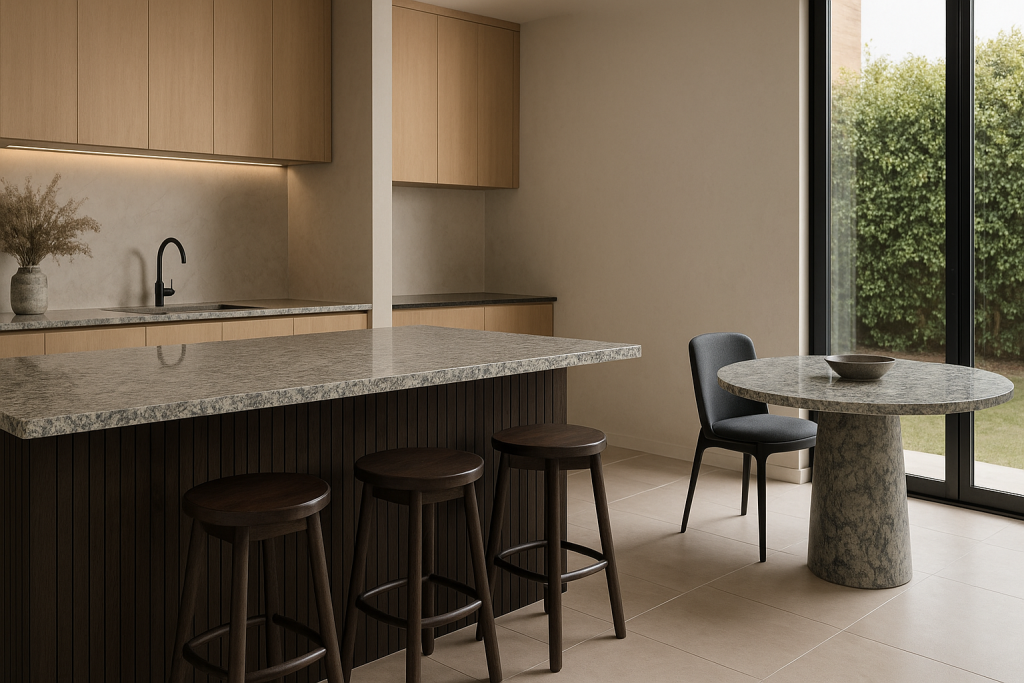
Why natural stone is trending again in “quiet luxury” interiors
The surface market spent years chasing one idea: uniformity. But as we move into 2026, “quiet luxury” is pulling design back toward materials that feel authentic—calm from a distance, rich up close. Granite fits this shift because it carries real mineral depth and a grounded, architectural weight that engineered patterns often struggle to replicate in person.
This comeback is also practical. Homeowners, developers, and hospitality operators are thinking in lifecycle terms: fewer replacements, fewer complaints, fewer “special care” rules. Granite’s durability and everyday tolerance make it a reliable upgrade that still looks premium under changing trends and lighting plans.
If you want a buyer-friendly reference point for how a factory frames granite selection around real applications and outcomes, start with granite countertops and focus on how the material is positioned for kitchens, dining spaces, and projects—not just colour names.
What makes granite “project-ready” rather than just “good-looking”
Granite’s strength story is rooted in geology. As an igneous stone rich in hard minerals, granite typically performs well against daily abrasion and incidental impact, which is exactly what counters and dining surfaces face in real life. But for buyers, “project-ready” granite is less about hardness and more about predictable visual performance once installed.
A countertop isn’t judged like a slab photo. It’s judged under multiple light sources, from multiple angles, across seams, corners, and cut-outs. That’s why professional buyers lock three decisions early:
- Light behaviour: how the stone reads under warm vs cool lighting, and under direct vs diffused light
- Pattern repeat: what happens when the surface becomes a large field and seams appear
- Finish logic: polished vs honed vs leathered, and how each changes reflection and smudge visibility
When these are defined upfront, natural variation becomes controlled character rather than messy inconsistency.
The “deadly details” that cause granite regret
Most granite regrets happen not because the stone is poor, but because the buying rules were vague. The most common traps look like this:
- Approving one small sample, then expecting the entire shipment to match it perfectly
- Ignoring seam placement until fabrication day
- Choosing a finish in showroom lighting that doesn’t match the real kitchen
- Underestimating how a pattern feels once repeated across a long island
A quick reality check: a slab that looks calm in a warehouse can look busy at night under cool downlights. And a beautiful movement can become chaotic when it repeats across multiple pieces.
For buyers who want to narrow faster without guessing from one glam photo, this shortlist-style reference is useful because it focuses on repeatable kitchen outcomes: 8 most valuable natural granite for countertops.
This is why serious buyers shortlist from a slab-focused category first, where the decision starts with movement and tone families rather than random photos. A clean way to do that is to begin with granite countertops, then narrowing to a small set of candidates that match the project’s design intent.
A fast “use-test” before approving any granite slab
Before you approve granite, run this simple test. It prevents most expensive surprises.
- Identify the strongest light source in the real space
Downlights, window lines, and pendants can radically change how granite reads. - Mark the stress zones
Sink cut-out, cooktop zone, main seam line, and the main viewing angle from the entry. - Ask one decisive question
Will the pattern feel calmer when repeated across a large surface—or will it turn noisy?
Then match the granite to the role you need:
- If the room already has bold elements (statement backsplash, strong cabinetry, patterned floors), choose lower-movement granite for balance. A calm, light-tone benchmark many buyers reference when defining “controlled movement” is Alpine White granite slab.
- If the room is minimalist, granite can be the hero surface—but seam planning becomes non-negotiable. For high-impact statement looks, a hero option like Titanium Gold granite makes slab pairing and seam logic even more important.
- If the order is phased or multi-unit, prioritise stable tone families so later reorders don’t drift.
Why granite is winning again against “perfect uniformity” surfaces
Engineered surfaces excel at consistency—and for some projects that’s perfect. But luxury trends are moving toward tactile realism: surfaces that look and feel “true,” not printed. Granite delivers that naturally. It also offers buyers a psychological benefit: it reads as an asset, not a decorative layer. In resale-driven markets and hospitality environments, that perception matters.
Granite also pairs well with today’s leading interior directions:
- Warm neutrals and natural woods
- Matte fixtures and brushed metals
- Layered lighting that highlights texture
- Minimalist spaces that need one material to carry the room
If you want a quick buyer-facing baseline for what colours actually show up most in kitchens, this reference is practical: most popular granite countertop colors for kitchens.
This is why granite has shifted from “safe old-school choice” to “modern calm-luxury surface” when selected with the right movement and finish.
Trend spotlight: granite furniture is becoming a design statement again
In recent years, granite has been moving beyond countertops into furniture—especially dining, a shift that continues to gain momentum heading into 2026. Designers are choosing fewer pieces but making them more permanent and sculptural. Stone tables act like anchors: they stabilise a space visually and instantly signal premium intent.
Round tables are particularly popular because they soften modern interiors and improve flow. They also reduce the “sharp edge” visual tension that rectangular tables can bring to compact open-plan layouts. A practical example of this trend is a round granite dining table—a format that suits modern homes, boutique hospitality dining rooms, and restaurant spaces that need both style and durability.
What to ask before ordering granite for a project
Good sourcing sounds less like negotiation and more like specification. These questions keep outcomes controlled.
For granite slabs
- What tone window is acceptable for the order, and how is it managed across the batch?
- Can slabs be grouped by visual family (island vs perimeter, public vs private zones)?
- Which finish best supports the design goal—calm modern or glossy dramatic?
- How should seam placement be planned to minimise visual disruption?
For granite dining tables
- How is flatness controlled and inspected before packing?
- What edge profile is recommended for comfort and durability in daily dining use?
- How is packing designed to prevent micro-chipping on corners and edges during export?
- What care guidance best matches residential vs hospitality use?
Conclusion: granite’s advantage is control, not perfection
Granite will never be identical—and that’s not the point. The goal is controlled character: calm surfaces, seams that don’t shout, finishes that match lighting, and batches that stay inside your tone window.
That’s why granite slabs are winning again, and why granite furniture is becoming a modern design statement. With the right selection rules and a factory that understands project logic, granite stops being a gamble and becomes one of the most reliable ways to build timeless, high-impact spaces.
FAQs
1. Are granite slabs still considered “modern” for 2026 interiors?
Yes. The modern shift isn’t about making stone look uniform—it’s about selecting granite with controlled movement and finishes that suit layered lighting and calm, architectural spaces.
2. What’s the biggest reason granite looks “messy” after installation?
Unclear selection rules. When tone range, movement level, and seam direction aren’t defined early, natural variation turns into visual inconsistency.
3. Which granite finish works best for “quiet luxury” kitchens?
Honed or leathered finishes often feel more calm and tactile under layered lighting, while polished finishes can look brighter but may show reflections and smudges more clearly.
4. How do buyers reduce seam visibility on granite countertops?
Plan seams before fabrication, place them away from high-sightline zones, and pair slabs so vein movement feels continuous rather than interrupted.
5. Can granite work for hospitality projects and repeat orders?
Yes—if the tone window and visual grouping rules are documented, and slabs are controlled as a batch (especially across phased projects).